Key Takeaways
- Industrial cables need protection from abrasion, impact, heat, moisture, chemicals, vibration, and repeated movement.
- The right solution depends on where the cable runs, how often it moves, and what it may contact during normal operation.
- Good routing improves safety, makes troubleshooting easier, and helps prevent avoidable downtime.
- Damaged cables should be removed from service rather than covered with a temporary repair.
- Cable protection supports, but does not replace, qualified electrical work and established energy-control procedures.
Cables used near machinery, automated systems, service benches, and production lines face conditions that ordinary office cords rarely encounter. They may rub against frames, flex with moving equipment, pass through dusty areas, or sit near fluids, heat, carts, and foot traffic. Selecting suitable protection early can help keep wiring organized while reducing unnecessary wear.
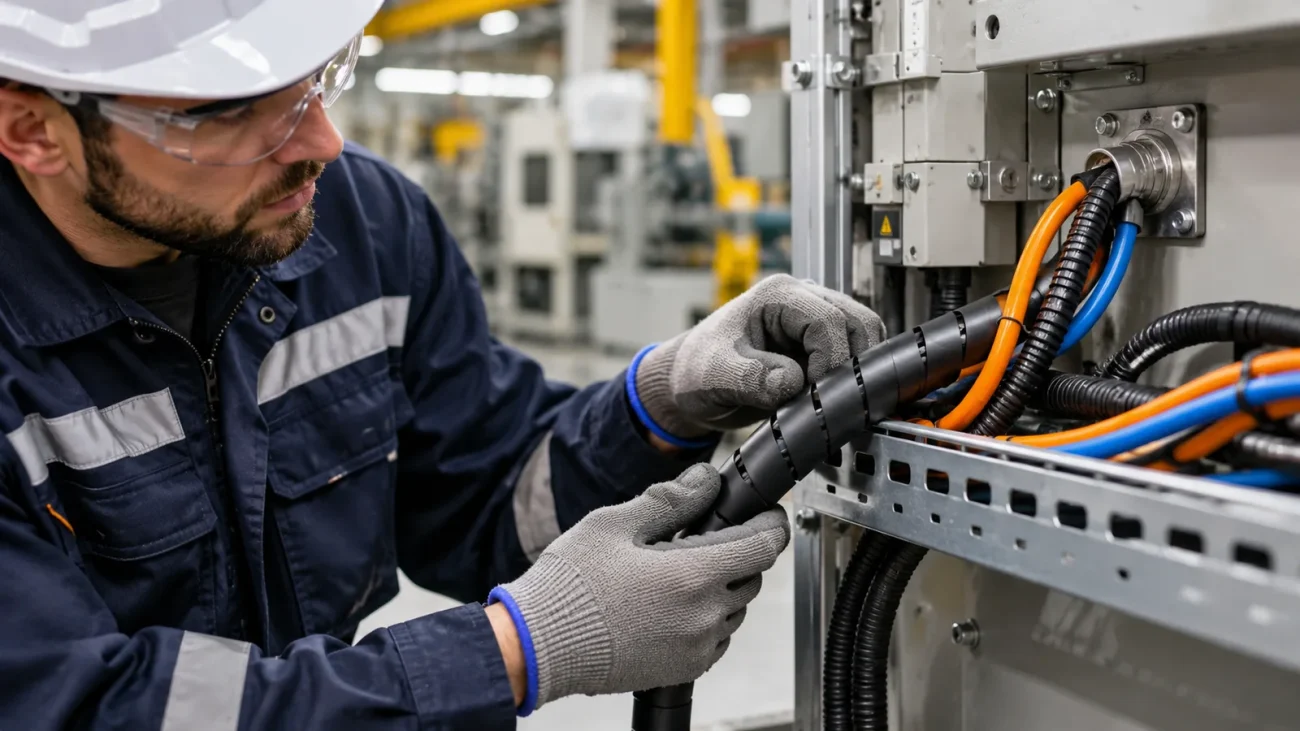
Planning the route before equipment is fully installed can also reduce later rework. It allows teams to identify likely crossing points, service clearances, enclosure entry locations, and areas where a cable may need extra guarding or a more durable jacket. For bundled wires, hoses, and cords that need flexible coverage and easy branch-outs, Newman Heli-Tube spiral wrap is one option to consider as part of a broader cable-management plan.
The best choice still depends on the cable jacket, the operating environment, required access, and whether the installation is stationary or continuously moving.
Why Basic Organization Is Not Enough
A neat cable run is useful, but appearance alone does not prevent failure. A cable can look orderly while being pulled too tightly, bent beyond its recommended radius, exposed to sharp edges, or pinched at a moving joint.
Over time, those conditions can damage the outer jacket, stress conductors, loosen terminations, or interfere with signal performance. Industrial cable routes should also support service access. When technicians can trace a run from its power source to the connected equipment, inspect supports and connectors, and clearly identify circuits, routine maintenance becomes more manageable.
Labeling and intentional routing can also reduce the chance of disconnecting the wrong cable during a repair. Clear organization also makes changes easier to manage. When additions, replacements, or equipment moves are required, documented routes and visible labels help personnel determine which cables can be accessed safely and which protective components may need updating.
Common Causes of Cable Damage
Most cable damage can be traced to a limited set of recurring conditions. Flexible cords are particularly vulnerable because they are exposed, unsecured, and designed to move. OSHA notes that abrasion, aging, unsuitable fasteners, and damaged insulation can expose conductors and create shock, burn, or fire hazards; its guidance on protecting flexible cords from damage also emphasizes proper strain relief and protection from wet conditions.
- Abrasion: Repeated rubbing against brackets, machine frames, floors, panels, or neighboring cables can wear through a jacket.
- Tight bends: Small-radius turns can stress a cable, especially near connectors, glands, and entry points.
- Vibration: Continuous machine vibration can loosen supports and fatigue cables at attachment points.
- Impact and crushing: Tools, carts, forklifts, pallets, and dropped materials can flatten or cut exposed runs.
- Heat, cold, and fluids: Temperature extremes, water, oils, and process chemicals can affect cable jackets and connector seals.
- Tension and twisting: Pulling on a cable instead of its connector or strain-relief point can damage internal conductors.
Damage may begin at a single point of contact and remain hidden until the jacket has worn significantly. Areas close to doors, access panels, hinges, machine guards, and equipment bases deserve particular attention because normal operation can repeatedly bring cables into contact with surrounding surfaces.
Choose Protection for the Actual Environment
Protection should be chosen after reviewing the cable’s real operating conditions, not just the equipment’s intended use. A sleeve that is appropriate inside a dry control enclosure may be unsuitable for a washdown zone, outdoor installation, welding area, robotic arm, or moving conveyor.
Questions to Ask Before Selecting a Method
- Will the cable remain stationary, flex occasionally, or move through a repeated cycle?
- Could it contact water, oil, dust, chemicals, sunlight, hot surfaces, or sharp edges?
- Will pedestrians, carts, or vehicles cross the route?
- What bend radius, temperature range, and cable rating must be maintained?
- How often will the cable need inspection, adjustment, or replacement?
- Are the connectors, fittings, glands, and supports compatible with the chosen protection?
It is also useful to consider how the installation may change over time. A route that is easy to access and modify can be preferable to one that appears compact at first but makes future inspection, cleaning, or equipment replacement unnecessarily difficult.
Main Types of Cable Protection
Different protection methods solve different problems. In many installations, the most effective approach combines several of them rather than relying on one product.
- Flexible conduit: Useful where cables need a protected path through areas exposed to contact, dust, or moisture.
- Braided sleeving: Often used for abrasion resistance and a clean, flexible finish around grouped cables.
- Spiral wrap: Helps bundle wires and hoses while allowing breakouts and later changes along the run.
- Heat-shrink tubing: Can provide insulation, sealing, or added support over selected cable sections and terminations.
- Cable carriers: Guide cables through controlled travel on automated equipment, gantries, and moving machine components.
- Trays and raceways: Support organized routing across equipment frames, walls, ceilings, and longer plant runs.
- Floor cable protectors: Help shield temporary or exposed runs where people or wheeled equipment may cross.
Protection should not make inspection impossible. Select products and installation methods that allow technicians to open, remove, or examine the covering when needed, especially around splices, connectors, transition points, and sections subject to regular movement.
Route Cables for Safety and Service Access
Start with the route itself. Keep cables away from pinch points, sharp metal edges, standing water, hot surfaces, and moving machine components. Use supports that can carry the cable bundle without crushing it, and avoid leaving excess loops where employees may trip or where the cable can snag.
- Respect the cable manufacturer’s minimum bend radius.
- Provide enough slack for normal movement and service work, but not enough to create a hazard.
- Use strain relief where cables enter enclosures, plugs, junction boxes, and moving equipment.
- Separate power wiring from sensitive communication or control wiring when the application requires it.
- Label both ends of important runs and keep disconnects accessible.
- Inspect entry points, clamps, and high-contact areas more frequently than protected stationary runs.
When several cables share a route, account for the bundle’s combined size and weight. Supports should be spaced and selected for the installation so that individual cables are not carrying the weight of adjacent runs or being forced into sharp bends at transition points.
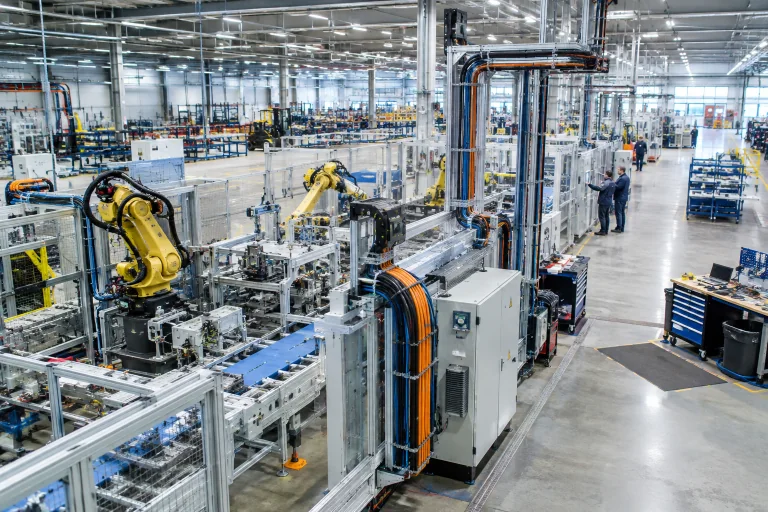
Protecting Cables on Moving Machinery and Robotics
Repeated movement places special demands on a cable system. A cable suitable for stationary routing may fail prematurely if installed on a robotic arm, sliding carriage, rotating fixture, or other high-cycle assembly.
The cable, carrier, supports, and connection points must work together through the full range of movement. Measure the travel path, confirm the cable’s flex capability, and make sure the route prevents twisting or sudden tension at either end. Cable carriers and guides can help control movement, but they must be sized and loaded correctly.
High-cycle sections should be included in a more frequent inspection schedule. Observe the machine through its full operating travel after installation. A route may appear acceptable while stationary but reveal rubbing, insufficient slack, or interference only at the limits of extension, rotation, or retraction.
Build a Practical Inspection Routine
- Look: Check for cuts, cracks, flattening, exposed conductors, damaged connectors, loose supports, and worn protective coverings.
- Trace: Follow the cable from source to equipment, including hidden sections, entry points, and moving areas.
- Check safely: When equipment is de-energized, and site procedures permit, look for stiffness, soft spots, heat damage, and movement at fittings.
- Record: Note the location, condition, corrective action, and inspection date so recurring problems can be identified.
- Remove damaged items: Take unsafe cables out of service instead of relying on tape or other temporary fixes.
Inspection frequency should reflect the environment and the consequences of failure. Cables exposed to daily motion, traffic, vibration, fluids, or heat generally warrant closer attention than protected runs located in stable, low-contact areas.
Keep Cable Protection Connected to Electrical Safety
Cable management is not a substitute for electrical safety procedures. Electrical work should be assigned to qualified personnel, and maintenance tasks should follow site requirements for de-energization, lockout, verification, and the use of appropriate protective equipment.
The CDC explains that electrical safety in the workplace includes controlling risks from shock, burns, arcing, and faulty equipment. Before inspecting or modifying an electrical cable installation, workers should follow the facility’s established procedures and understand the equipment involved. Protective coverings can reduce physical damage, but they do not make energized work safe or eliminate the need for proper controls.
Common Mistakes to Avoid
- Choosing protection based only on cost or appearance.
- Overfilling conduit, trays, or cable carriers.
- Using ties or clamps tightly enough to deform the cable jacket.
- Leaving cables against sharp edges, hot surfaces, or wet connectors.
- Ignoring small signs of abrasion at high-movement locations.
- Failing to update labels and routing records after equipment changes.
Conclusion
Effective cable protection begins with understanding movement, exposure, access needs, and likely points of contact. Teams should consider how cables may be affected by equipment movement, heat, moisture, chemicals, vibration, foot traffic, and repeated handling before choosing a protection method.
By combining sound routing, appropriate protective materials, reliable strain relief, routine inspections, and safe electrical practices, industrial teams can reduce unnecessary wear and identify developing problems before they lead to equipment downtime or more serious damage. Clear labeling and organized cable runs can also make inspections, repairs, and future modifications easier.
Protection should be reviewed whenever equipment, layouts, or operating conditions change. With practical planning and regular maintenance, cable systems can remain easier to access and manage while being less vulnerable to preventable damage.
