In the last days of December 1734, in a farmhouse at the head of the glen of Balquhidder, an old man was dying in a box bed.
He was sixty-three, which was a good age for a man who had spent twenty years as an outlaw. He had been a cattle dealer, a bankrupt, a rebel, a prisoner more than once, and the most famous rogue in Scotland. A book had been written about him in London while he was still alive. Now his lungs were failing, and his family were gathered round. He wore a plaid all his life, and his name now belongs to a red and black check, the Rob Roy MacGregor tartan.
Word came to the door that a visitor was on his way up the glen: one of the MacLarens, with whom the old man had lately had a bitter quarrel over land. The family wanted to send the caller away. The dying man would not hear of it.
“Raise me from my bed,” he said. “Throw my plaid around me. Bring me my claymore, my dirk and my pistols. It shall never be said that a foeman saw Rob Roy MacGregor defenceless and unarmed.”
They did as he asked. They sat him up in a chair, wrapped in the great length of tartan, with his weapons about him, and the visitor was shown in. The two men exchanged cold civilities, and the MacLaren left. “Now,” said the old man, “it is all over. Put me to bed. Call the piper. Let him play Cha till mi tuille.” It means I shall return no more. He was dead before the tune was finished.
That, at least, is how the story was told to Sir Walter Scott, and it has been told the same way ever since.
The nameless clan
He was born in 1671 at Glengyle, at the head of Loch Katrine, the third son of a MacGregor chieftain. Roy is the Gaelic ruadh, red, for his hair. But through most of his life he could not legally use the name he was born with.
The MacGregors were the unluckiest clan in the Highlands. They held their lands by the sword and had no charters for them, and their powerful neighbours, the Campbells above all, got charters instead and called the MacGregors trespassers. Dispossessed, they turned to raiding. In 1603, after they slaughtered a force of Colquhouns in Glen Fruin, the King’s patience snapped. The very name of MacGregor was abolished by Act of the Privy Council. To bear it was death. MacGregors could be hunted with dogs. Their women were branded on the face. They took other surnames and survived as “children of the mist.” Their motto is ’S rioghal mo dhream, royal is my race, and it was for a long time about all they had. The name was not fully restored until 1774.
So Rob Roy signed himself Robert Campbell, his mother’s name. And for years he prospered. He was a drover, buying black cattle in the Highlands and walking them south to the Lowland markets, which was big business and perfectly respectable. His chief backer was the Duke of Montrose.
In 1712 it all collapsed. Rob had borrowed a thousand pounds from the Duke to buy cattle. His head drover vanished with the money. Montrose did not wait for explanations. He had Rob declared a fraudulent bankrupt and an outlaw, seized his lands at Craigroyston on Loch Lomond, and had his wife and children turned out of their house in midwinter.
Rob Roy took to the hills above Loch Lomond and spent the next dozen years making the Duke regret it. He lifted Montrose’s cattle. He kidnapped Montrose’s factor and collected the Duke’s rents himself, giving the tenants proper receipts. He ran a protection business along the Highland line. He was captured at least three times, and each time he got away. On one occasion, the story goes, he was being taken across the River Forth at the Fords of Frew, strapped by a belt to the man riding in front of him. Halfway over, in the dusk, he talked his guard into loosening the buckle, slid from the horse into the water, and let his plaid float away downstream to draw the fire while he swam for the bank.
He was pardoned in the end, and died in his bed. His grave is in the kirkyard at Balquhidder, under the words MacGregor Despite Them.
The simplest tartan there is
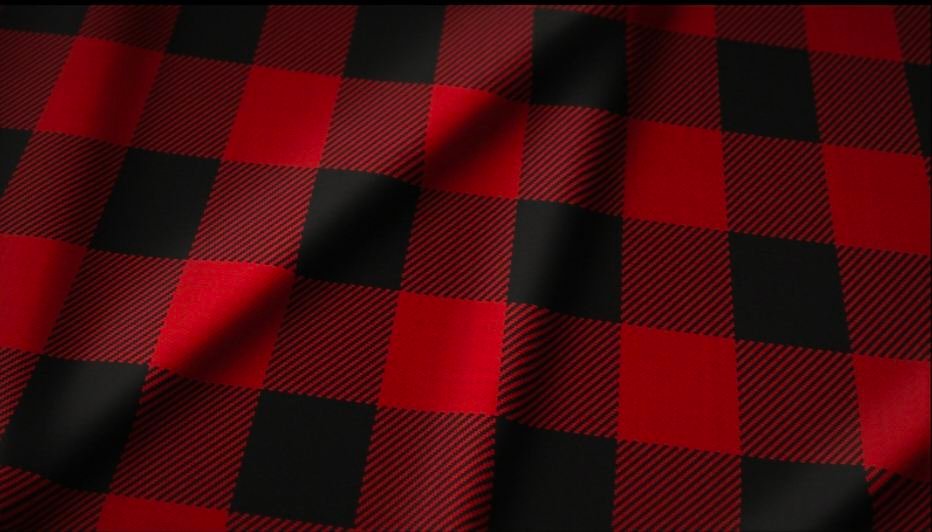
The tartan that carries his name is as plain as a tartan can be. It is a check of two colours, red and black, in equal squares. That is all. There are no fine lines and no third colour, nothing to get wrong.
Did he wear it? Nobody can say. The tartan historian D. W. Stewart looked into it in the 1890s and found no documentary evidence. What is certain is that the pattern is old and that it was MacGregor. When the Highland Society of London collected authenticated tartans from the chiefs in 1815 and 1816, the chief of Clan Gregor, Sir John MacGregor Murray, sent in a piece of this red and black check with his seal on it and a label in his own hand: “The MacGregor Tartan for undress ordinary clothing.” It was the clan’s everyday cloth, as against the more elaborate red and green sett kept for best. It is in the 1819 pattern book of the Bannockburn weavers too. After Scott published his novel in 1817, Rob Roy’s name became attached to it, and has never come off.
North Americans will recognise it at once. It is the same check as the buffalo plaid of lumberjack shirts. There is a well-worn tale that a Scottish trader carried the MacGregor check to the American frontier, but it is folklore and no more.
The Rob Roy MacGregor tartan is widely available today, made to order as kilts, skirts, waistcoats, scarves and ties, or sold by the yard. Because it is so bold and so simple, it makes an extraordinarily striking formal kilt. Under a black jacket, the black squares merge with the coat and the red ones burn. For formal wear the check also makes up into fly plaids, pinned at the shoulder with a brooch.
What a plaid was
The plaid that Rob Roy called for on his deathbed was not an accessory. It was his clothing.
The Highland dress of his day was the féileadh mòr, the great wrap, which English speakers called the belted plaid. It was one enormous piece of tartan, five feet wide and four to six yards long. To put it on, a man laid his belt on the ground, spread the cloth over it, gathered the middle into pleats by hand, lay down on top of it, folded the two unpleated ends across his body and buckled the belt. When he stood up, the lower half hung to his knees as a kilt. The upper half hung from his waist behind him, and could be drawn up over one shoulder and pinned, wrapped round both shoulders as a cloak, or pulled right over his head in the rain. At night he unbuckled the belt and the whole thing became a blanket. When Rob Roy slipped into the Forth, it was this he let go.
During the eighteenth century the lower half was cut away and sewn with permanent pleats, and became the kilt as we know it. The upper half survived only as ceremony. Pipers wear a full plaid wound round the body. For everyone else there is the fly plaid: a square of tartan about four and a half feet across, fringed on all sides, gathered at one corner, fixed at the left shoulder with a brooch and left to hang down the back. It does nothing at all. It is there to remember the garment a Highlander lived and slept and died in.
Balquhidder, a Friday in late September
Ryan McGregor and Hannah Lindqvist, both from Boulder, Colorado, are being married at two o’clock beside the ruined old kirk at Balquhidder, thirty yards from Rob Roy’s grave. There are fourteen guests. The hills on either side of Loch Voil are the colour of rust, and it is, against all the odds, not raining.
Ryan’s family left Perthshire for Ontario in the 1850s and drifted west. He grew up knowing the name was Scottish and nothing else. He found out the rest in his twenties, read everything, and when Hannah said she wanted to elope somewhere with mountains, he knew exactly where.
He is wearing the red and black check, eight yards of it, with a black Prince Charlie jacket. On his left shoulder is a plaid of the same cloth. He ordered it with the kilt from Scottish Kilt, whose fly plaids are made for formal Highland dress, pinned through the left epaulette over a Prince Charlie or a formal Argyll, and matched to the kilt. With a tartan of only two colours, matching is everything. A red from a different dye lot would show at once, so kilt and plaid were cut from one run of cloth.
The brooch took him longer than the kilt. The same page offers them in a dozen designs, all round, all silver, in bright or antique finish: a thistle, a stag’s head, a lion rampant, a Celtic knot, a harp for the Irish. Some have a coloured stone set in the centre. He went for a plain antique-finish disc with interlaced knotwork and no stone, on the grounds that the tartan was loud enough already, and had the rest of his metal, the buttons, the sporran top, the kilt pin, in the same dull silver.
The photographer, a local woman, pinned it for him in the car park, having done it a hundred times. Pleated corner up under the epaulette from behind. A few inches pulled through to the front. Brooch pushed through the pleats and through the jacket, high on the chest, just under the shoulder seam. The rest left to hang straight down the back to the knee.
“High up, or it’ll pull your jacket squint,” she said. “And take it off before the ceilidh or you’ll strangle your wife.”
After the vows they walk across the grass to the grave, the three flat stones inside their iron rail. Somebody has left a miniature of whisky and a few coins on it, as somebody always has. Ryan stands for a minute in his red and black, the plaid stirring behind him in the wind off the loch.
“MacGregor despite them,” reads Hannah. “Despite who?”
“Everyone,” says Ryan. “They abolished the name. For a hundred and seventy years it was illegal to be called what I’m called.” He touches the plaid at his shoulder. “When he was dying, someone he hated came to the door, and he made them get him up and put this on him first. Not this one. The real thing, the big one. He wasn’t going to be seen without it.”
Hannah looks at the stone, and at him.
“Well,” she says. “You’re certainly being seen.”
I shall return no more
Rob Roy MacGregor was no saint. He was a cattle thief and an extortioner with a grievance and a great deal of charm, and he has been thoroughly romanticised. But the deathbed story, true or not, has lasted because it says something that people recognise. He had lost his name, his land and his good credit. He still had his plaid, and he would meet an enemy dressed in it or not at all.
The kilt kept the practical half of that garment. The fly plaid keeps the other half, the part that was about pride. Pinned to the shoulder of a man getting married, in a check of red and black, it serves no practical purpose, and people wear it anyway, for the same reason he asked for his.
