Every parent knows the scene: it’s 4:30 p.m., you’re exhausted, dinner isn’t started, and your child is either glued to a screen or melting down. This is the moment most parenting advice fails you. But what if the chaos of everyday life the kitchen, the grocery store, the bath was actually the most powerful classroom your child will ever have?
“Active learning” isn’t about flashcards or elaborate sensory bins. It’s the simple, research-backed idea that children learn best by doing, choosing, and exploring, not by sitting still and listening . The term “fparentips” may be unconventional, but the intent behind it is universal: parents want practical, real-world tips that fit into their actual lives. This guide is exactly that no guilt, no Pinterest-perfect setups, just everyday moments turned into real learning.
The 4:30 P.M. Slump Is an Active Learning Opportunity
The late-afternoon meltdown is not a discipline failure. It’s a signal. Your child’s brain has been holding it together all day, and the unstructured, low-energy gap between school and dinner is when their need for connection and engagement peaks. Instead of fighting this moment, use it. Hand them a job that matters: tearing lettuce, sorting laundry by color, or deciding which pot is biggest.
These tiny tasks are active learning in disguise. When a child measures rice for dinner, they are doing math. When they choose between two shirts, they are practicing decision-making. HighScope, the renowned early childhood organization, emphasizes that learning continues everywhere at home, in the park, at the grocery store and that parents often support it without even realizing . The slump becomes the learning window.
What Active Learning Really Means at Home
Active learning does not mean your child is constantly entertained. It means they are mentally and physically engaged in what they are doing. The child is not a spectator; they are fully involved in manipulating, testing, and talking about their experiences . This distinction matters because it frees you from the pressure to “teach” constantly.
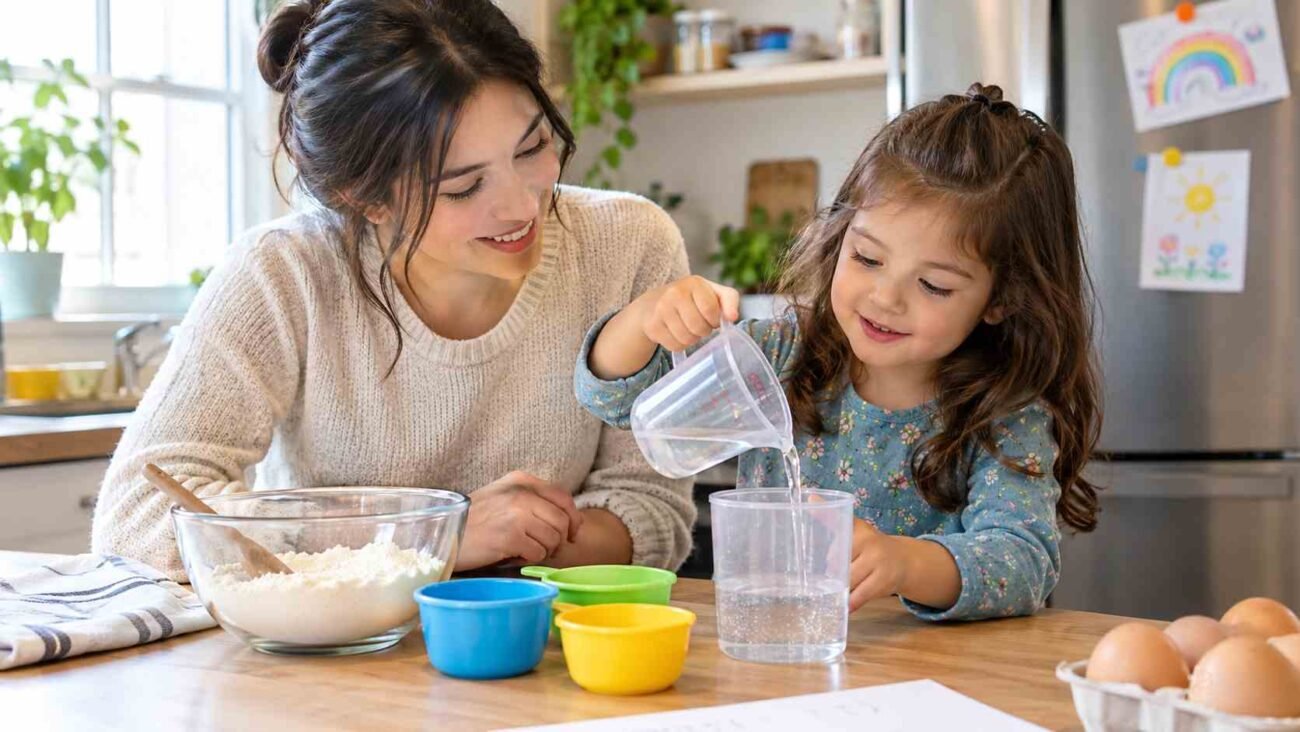
At home, this looks unremarkable. A toddler pouring water between cups is discovering volume. A preschooler stacking blocks is exploring balance and cause and effect. The ingredients are simple: open-ended materials, time, choice, and an adult who observes and supports without taking over . You do not need a curriculum. You need trust in your child’s natural drive to figure things out.
Why Blocks Teach More Than Worksheets
A worksheet asks a child to recall a fact. A block tower asks a child to predict, test, and adjust. When a child builds with blocks, they are not just playing; they are exploring physics, spatial reasoning, and problem-solving. Research consistently shows that hands-on, self-directed play builds critical thinking more effectively than passive instruction because it forces the child to test an idea and adapt when it fails.
The Illinois State Board of Education puts it plainly: play is not a break from learning play is learning . Self-regulation and executive functioning skills, which are the strongest predictors of later academic success, are built when children negotiate turns, manage frustration, and try again after a tower falls . A worksheet can be completed with a blank stare. A block tower demands genuine engagement.
Your Role: Observe, Wait, Follow Their Lead
The hardest part of active learning for many parents is stepping back. Your instinct is to correct, to demonstrate, to ensure the activity is “done right.” But active learning requires a different posture. HighScope’s framework is clear: the adult should observe, encourage, and support without taking over . This means watching before intervening, giving the child time to struggle productively, and following their initiative rather than directing the play.
This does not mean abandoning your child. It means being present without controlling. If your child is trying to fit a square block through a round hole, don’t hand them the round block. Watch. Wait. Let them feel the mismatch. When they look to you, you might ask, “What else could fit?” The struggle is where the learning lives . Your quiet confidence in their ability is the most powerful teaching tool you have.
You Don’t Need a Learning Space Just a Kitchen and a Grocery Cart
The idea of a dedicated “learning space” is a modern invention that mostly serves adults. Children learn wherever they are allowed to participate. The kitchen is a laboratory: measuring flour is math, watching butter melt is science, stirring batter is coordination. The grocery store is a classroom: comparing prices, counting apples, finding the shortest line all of it builds real-world skills .
Bath time is another underrated window. A child squeezing a sponge learns about absorption. A child pouring water from a cup to a bottle discovers volume and trajectory. These are not elaborate setups. They are the fabric of daily life, and they are enough. As HighScope notes, supporting active learning at home is not about doing more it is about doing things differently . A careful eye and a little trust are all you need.

When Your Child Says “I’m Bored” — 5 Prompts That Work
Boredom is not an emergency. It is a pause that invites creativity and problem-solving . When your child says “I’m bored,” resist the urge to solve it immediately. For younger children, the phrase might actually mean they need connection, movement, or food . For older children, it is often a signal that they need a small nudge to start their own engine.
Instead of offering a screen or an activity, try a prompt. “What’s one thing in this room you could build with?” “What would happen if we mixed these two things?” “Can you find three things that are round?” “What’s a game you could invent with these socks?” “How many ways can you move from here to the door?” These questions scaffold without solving. They hand the thinking back to your child, which is exactly where it belongs .
Screen Time vs. Active Time: Compete Without Guilt
Screens are not the enemy, but they are not a substitute for active learning. Passive screen time watching a video, tapping a game does not build the same neural connections as hands-on exploration . That said, guilt is not a useful parenting tool. The goal is not perfection. The goal is balance that works for your family.
The American Academy of Pediatrics recommends no more than one hour of high-quality programming for preschoolers, with parents co-viewing and engaging . That co-viewing matters. When you watch together and ask questions—”Why do you think that happened?” you turn a passive experience into a social one. But the most reliable way to reduce screen battles is to make the offline world more interesting. A child who is deeply absorbed in building a cardboard castle is not asking for a tablet. Your job is not to eliminate screens. Your job is to make sure screens are not the only option.
When Active Learning Feels Like One More Chore
The phrase “active learning” can feel like another item on an already impossible to-do list. But the HighScope philosophy offers a reframe that changes everything: it is not about doing more. It is about doing things differently . You do not need to add a “learning activity” to your day. You need to let your child into the things you are already doing.
Let them stir the eggs, even if it takes longer. Let them push the grocery cart, even if it is erratic. Let them choose their own clothes, even if the pattern clashes. These small surrenders of control are not extra work they are less work, because a child who is engaged is a child who is not fighting you for entertainment. Active learning is not a new burden. It is a different lens on the life you are already living.
The 10-Minute Rule That Changes the After-School Hour
Ten minutes of undivided attention can transform the entire evening. This is not a scientific law, but it is a pattern many parents discover: when a child receives a small, reliable dose of one-on-one connection, they are less needy for the rest of the evening. The 10-minute rule is simple. When your child comes home, before you check your phone, before you start dinner, sit with them. No agenda. No teaching. Just be with them.
What you do in those ten minutes matters less than the consistency. Let them lead. If they want to show you a rock, look at the rock. If they want to tell you a rambling story, listen. This is not “active learning” in the academic sense. It is connection, and connection is the prerequisite for everything else. A child who feels seen is a child who can then go play independently, explore, and learn. The ten minutes are not a break from learning. They are the foundation.
Build a Home Where Learning Isn’t “Scheduled”
The ultimate goal of active learning fparentips is not to produce a child who can recite the alphabet earlier than the neighbor’s kid. It is to build a home where curiosity is normal, where exploration is expected, and where learning is not confined to a designated time slot. This is a slow shift, not a one-time setup. It happens in the thousand small moments when you choose to let your child try, even when it is slower.
A home like this looks messy sometimes. It has a child-sized broom that actually gets used, a drawer of loose parts that becomes a robot, and a kitchen floor that is never perfectly clean. But it also has a child who knows that their ideas matter, that their effort is valued, and that the world is a place to be explored, not just observed. That is what active learning builds. Not a perfect child, but a capable one.
Frequently Asked Questions
1: What is active learning for parents?
Active learning means children learn by doing, choosing, and exploring not by sitting and listening.
2: How do I start active learning at home?
Start small let your child stir eggs, sort laundry, or pick their own clothes.
3: What if my child refuses to engage?
Offer a choice instead of a direction, and check for hunger, tiredness, or a need for connection first.
4: How much time does active learning take daily?
No scheduled block needed even 10 minutes of child-led play or one shared task counts.
5: Is screen time ever okay for active learning?
Yes, in moderationnespecially when you co-view and ask questions, but balance beats perfection.
6: What does “fparentips” mean?
It’s an informal term for practical, real-life parenting tips that fit busy family life.
7: Why are blocks better than worksheets for learning?
Blocks build problem-solving and critical thinking through hands-on testing, while worksheets mostly test recall.
Conclusion
Active learning fparentips is not a formula. It is a permission slip. Permission to let the blocks stay out, to let the grocery trip take longer, to let your child struggle with the square block and the round hole. The research is clear that children learn by doing, choosing, and exploring . But you do not need to memorize the research. You just need to trust what you already know: your child is a natural learner, and your home is already full of classrooms.
The 4:30 slump will still happen. The boredom will still arrive. The screens will still be tempting. But you will have a different response now. Not guilt, not a new activity to plan, but a simple shift: observe, wait, and follow their lead. That is the whole of it. The everyday moments are already there. You just have to let them count.

One thought on “Active Learning FParentips: Simple Tips That Fit Your Real Life ”