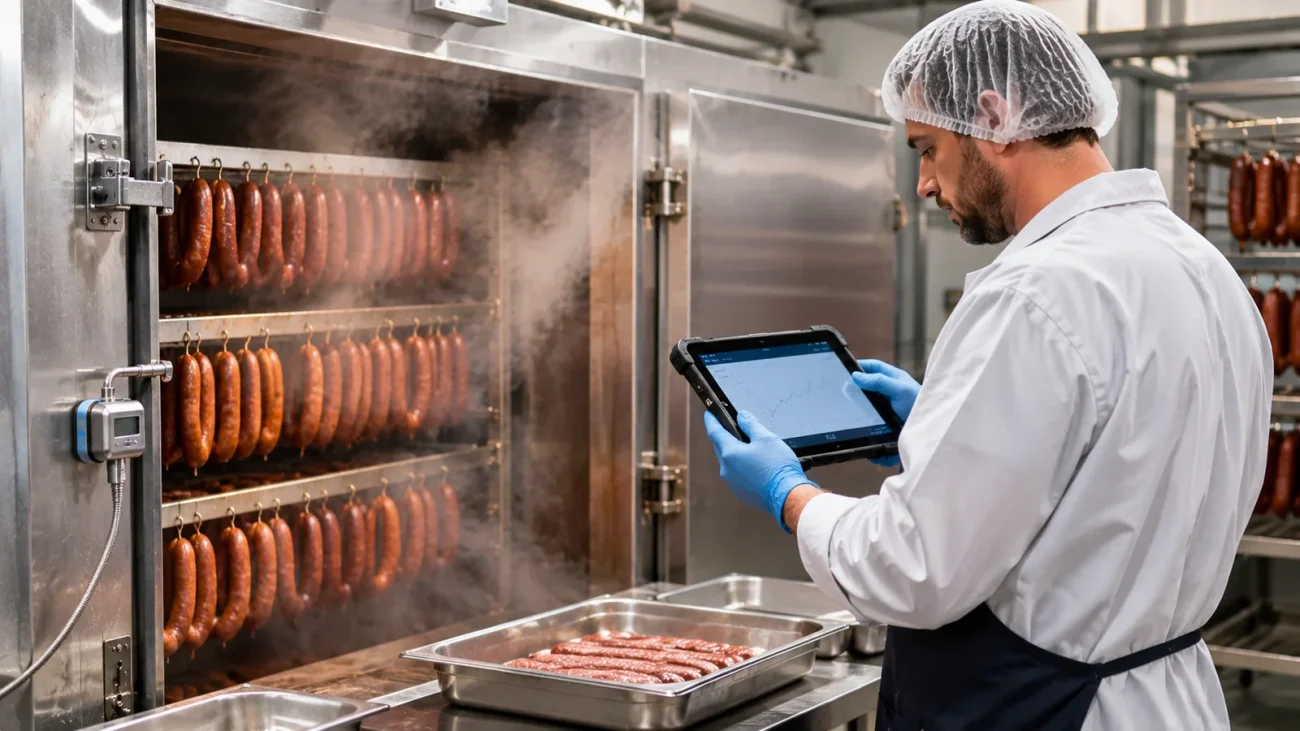
There’s a particular kind of pride in running a smokehouse well. The cycle begins, the temperatures climb right on schedule, and an experienced operator can tell from the sound and the smell that everything is going just as it should.
Alongside that craft sits something equally important: the evidence that shows the product was handled exactly as the plan requires. For USDA-regulated meat processors, that evidence is part of every run. The wonderful news is that many plants are finding a way to let it record itself, so the people who care so much about the work can spend more of their day enjoying it.
The Craft Behind Every Cycle
Meat processors operate with a high standard of care, supported by USDA regulations, HACCP documentation, and daily inspection requirements. Each run produces a rich set of records. Cook temperatures and Delta-T values show how the cycle progressed.
Weights tell the story before and after processing. Lethality evidence confirms that product reached the required conditions. Batch records, sanitation documentation, and traceability reports connect the run to the ingredients and customers on either side of it.
These records reflect the skill and attention of the people who keep them, and plants understandably take them very seriously. They’re also a natural place for helpful technology, because the information is already being generated by the run itself.
A Chance to Make the Paperwork Lighter
Traditionally, much of this evidence has been written down by hand: paper batch sheets traveling with the product, smoker readings copied from a panel to a form, formulas kept in spreadsheets. The care that goes into this is genuinely admirable, and it’s also time that experienced people could spend elsewhere.
Plants have noticed something encouraging about this part of the job. Because documentation is the area where manual entry has the most influence on accuracy, it’s also where improvement is most noticeable. Reducing manually entered data is one of the quickest ways to improve both day-to-day accuracy and regulatory confidence. In other words, this is a place where a small change makes a big, positive difference.
Evidence That Records Itself
The most welcome change is letting the record be created at the moment the work happens. This is where AI for Food Manufacturing offers a delightful benefit. AI-powered batch capture records Delta-T data, temperatures, weights, and lethality evidence automatically, at the source and during every run. Instead of operators carrying readings from one place to another and completing paperwork afterward, the compliance evidence is captured and organized as production unfolds.
Operators often describe this as a relief. The same careful attention goes into running the smokehouse, and the paperwork stops being a second job at the end of the shift. For quality teams, it means compliance records are built during production, not reconstructed before an audit. Everyone gets to focus on what they do best.
From Smoker Log to Audit Dossier in a Minute
Once evidence is captured at the source, it deserves a good home. Many plants bring batch records, smoker logs, quality records, and traceability documents together in a centralized production database, where everything is stored consistently and easy to find.
The effect on inspection days is something teams love to talk about. Responding to a USDA inspector has traditionally meant gathering records from binders, spreadsheets, and several systems, a process that can take two to three days of management time.
With a centralized database, an audit-ready dossier can be generated on demand, and every batch record, smoker log, quality record, and traceability document can be retrieved in under 60 seconds. The inspector’s request is the same as it has always been. The difference is that the answer is already waiting, and the day feels remarkably calm.
HACCP Control Points, Captured at the Moment They Matter
HACCP plans rely on critical control points, the steps where a measurement or check makes the difference for food safety. Automated capture suits these moments beautifully, because each reading is recorded as it happens, with a timestamp and the context of the run.
That continuity gives teams a clear, connected picture. If a quality reviewer wants to look back at a cook cycle, the temperatures, Delta-T values, and lethality evidence are all there, tied to the specific run. Daily reviews become quicker and more pleasant, and conversations with inspectors become friendly walk-throughs of well-organized evidence.
What Teams Enjoy Most
Plants that capture evidence at the source often describe a few favorite changes. Shift-end paperwork shrinks, because records are already built. Review meetings feel more constructive, since the data is complete and consistent. Audit preparation is largely done by the time the request arrives. And hours that used to go into compiling and double-checking go back into the work people love: running quality production, training colleagues, and refining processes.
There’s also a wonderful boost in confidence. When the people responsible for compliance know the records are captured accurately in every run, the whole team can approach inspection days with a smile.
One Story Across the Whole Journey
A smokehouse run is one chapter in a longer story that begins with raw material receipt and ends with a customer shipment. Being able to tell that whole story quickly is a real strength, and it pairs naturally with the run evidence.
This is where Lot Traceability Software built on a plant’s existing ERP completes the picture. Each production lot receives a traceability lot code automatically at the point of creation, tied to the raw material batch, production date, shift, line, and operator records.
Key data elements are captured at each critical tracking event, such as receiving, transforming, creating, and shipping, in a structured, sortable format. Forward and backward traces take seconds, so a single query can show which customers received a given lot or which raw material batches and suppliers went into a finished product. The system connects to the ERP through an API without changing its structure, so the team keeps the tools it already knows.
With run evidence and lot genealogy together, a plant can answer questions about the entire journey with ease. It also fits nicely with FSMA Rule 204, which asks for key data element records within 24 hours of a request, with a compliance date of July 20, 2028. Plants that build this foundation now are giving themselves a comfortable head start.
A Bright Way to Begin
For plants ready to start, a friendly first step is to choose one smokehouse and one product family. Notice how its evidence is recorded today, which readings are written by hand and where copying happens. Those moments show exactly where capture at the source will bring the biggest smile.
Then try a simple readiness check. Pick a real historical lot and see how long it takes to pull the run records and trace it to every ingredient lot and customer shipment. If it comes together in minutes, the plant is in great shape. If it takes more than a couple of hours, that’s a clear and rewarding place to begin, found on an ordinary day. A focused deployment on a single line commonly takes six to ten weeks, which gives a plant an early win to celebrate.
Craft and Confidence, Together
Meat processors have always held themselves to a high standard, and the people who run smokehouses bring skill and pride to every cycle. Letting temperatures, weights, and lethality evidence record themselves as the run unfolds lets that pride shine even brighter. With records built during production, stored in one place, and connected to every lot, audit day becomes a quick and confident conversation, and the team gets more time for the craft it loves.
About the Contributor
Nishkam Batta, Editor-in-Chief, HonestAI Magazine | AI Consultant, GrayCyan AI Solutions
Nish leads an applied AI company helping manufacturing and related companies automate operations with human-in-the-loop AI that integrates into ERPs, WMS, CRMs, and other enterprise tools, with an emphasis on explainable AI, clear audit trails, and measurable outcomes. His team builds agentic ERP systems that execute multi-step tasks inside approved guardrails so humans keep accountability, approvals, and override control.
